



Your Guide to 1920s Flapper Dresses
When we think of 1920s flapper dresses, it's easy to picture a wild swirl of fringe and beads on a dance floor. And while that’s part of the story, these dresses were so much more than just party clothes. They were a full-blown declaration of independence for women, marking a complete break from the stiff, restrictive clothing of the past.
Unpacking the Legend of the Flapper Dress
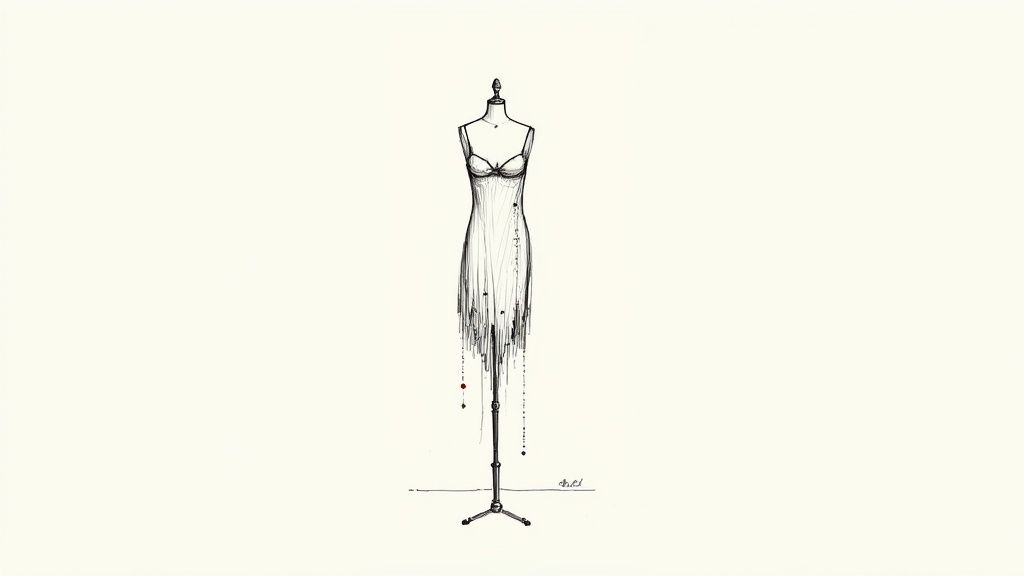
The flapper dress was less a piece of clothing and more a statement for the liberated "New Woman" of the Roaring Twenties. It tossed aside centuries of fashion rules that demanded women have tiny, cinched waists.
Instead of highlighting curves, the flapper dress dropped the waistline down to the hips. This created a straight, almost boyish look called the la garçonne silhouette. It was a direct rebellion against the painful corsets and heavy skirts our grandmothers had to endure.
A Symbol of Social Change
This new design wasn't just for looks—it was incredibly practical. The hemlines crept up, landing just below the knee by 1927. It was scandalous at the time, but absolutely necessary for women who were now driving cars and dancing the Charleston all night long. Things got so heated that some places, like the Federal Reserve, actually made dress codes to police skirt lengths! If you want to dive deeper, there are some great insights into 1920s fashion history out there.
The fabrics themselves were a huge part of this newfound freedom. Everything was about movement and flow.
To give you a clearer picture, let's break down the signature elements that make a flapper dress, well, a flapper dress.
Key Characteristics of a Flapper Dress
| Feature | Description |
|---|---|
| Silhouette | Straight and loose, often called la garçonne. It hangs from the shoulders and falls straight down, hiding the natural waist. |
| Waistline | Dropped to the hips, creating a long, lean torso. Sometimes emphasized with a sash or belt worn low. |
| Hemline | Knee-length or slightly below. By 1927, it was at its shortest, allowing for maximum movement. |
| Fabrics | Lightweight and fluid materials like silk, chiffon, and the newly popular rayon ("artificial silk"). |
| Embellishments | Ornate and heavy! Think intricate glass beads, shimmering sequins, metallic thread, and layers of fringe. |
| Neckline | Simple scoop or V-necks were common, designed to show off long pearl necklaces. |
These details all came together to create a look that was truly alive. The light fabrics and heavy embellishments worked in tandem.
- Silk and Chiffon: These were the go-to choices. They felt amazing, skimmed the body without clinging, and had a beautiful sway that was perfect for dancing.
- Rayon: This was the affordable game-changer. Known as "artificial silk," rayon let more women get in on the flapper trend without breaking the bank.
- Lavish Embellishments: All that beading, fringe, and sequin work wasn't just for show. The weight of the embellishments made the dress swing and catch the light, making every movement in a dimly lit jazz club absolutely mesmerizing.
In essence, the 1920s flapper dress was engineered for action. Every element, from its loose fit to its sparkling details, served the purpose of celebrating a woman's energy, independence, and presence in the public sphere.
The Silhouette and Fabrics That Defined an Era
Let’s get one thing straight: the flapper dress wasn't just clothing. It was a statement. The entire design was a middle finger to the rigid, corseted past, and it all started with a silhouette that completely changed the game.
It was all about the la garçonne or "boyish" look. Forget the tiny waists and exaggerated curves of the Victorian era. The 1920s dropped the waistline clear down to the hips, creating a straight, almost tubular shape that hung loose from the shoulders. This wasn't about hiding a woman's body; it was about setting it free.
This simple-looking shift was actually pretty brilliant. By de-emphasizing the natural waist, the dress gave women the freedom to move like never before. Think about it—you can’t exactly kick up your heels and do the Charleston when you’re cinched into a corset. This dress was made for the dance floor.
A New Generation of Fabrics
You couldn't create this new, free-flowing shape with the heavy, stiff fabrics of the old days. It just wouldn't work. The flapper dress demanded materials that were just as modern and liberated as the women wearing them—light, fluid, and ready to move.
A few key fabrics became the absolute stars of the show:
- Silk: You can't go wrong with silk. It's luxurious, light as a feather, and drapes beautifully. It just skims over the body without clinging, which was perfect for that loose, easy-breezy silhouette.
- Chiffon: This is what gave so many dresses that dreamy, ethereal vibe. Designers would often use it in delicate layers, making it look like the wearer was floating across the room. It added a gorgeous sense of weightlessness.
- Rayon: Honestly, rayon was a total game-changer. Back then, they called it "artificial silk," and it offered that same slinky, glamorous feel at a price regular women could actually afford. It's a huge reason the flapper style became so widespread.
These fabrics weren't just pretty; they were practical for the nightlife scene. When a woman moved, the material would catch the air and sway with her, turning her into a mesmerizing blur of motion in some dimly lit jazz club.
The Art of Embellishment
Okay, so the cut was simple. But the decorations? Anything but. The surface of a 1920s flapper dress was an absolute work of art, covered in dazzling, handcrafted details. And all that ornamentation had a secret job: its weight helped the lightweight fabric swing even more dramatically.
The real magic of the flapper dress is that it's a complete contradiction. You've got this simple, freeing silhouette loaded with incredibly complex, heavy decorations. It’s that exact mix that made it both comfortable and a total showstopper.
Beadwork was the main event. We’re talking thousands of tiny glass beads, all sewn by hand into incredible geometric Art Deco patterns or intricate floral designs. This was way beyond simple decoration; it was wearable art that took a wild amount of skill and time to create.
Then you had sequins and metallic threads woven in to add extra shimmer, designed to catch every little flicker of light in a speakeasy. But the real master of movement was fringe. Designers would place it along the hem, across the bodice, or in tiered layers—anywhere it could amplify a shimmy or a shake. The fringe made the dress itself feel alive, like it was dancing right along with you.
Telling Authentic Vintage from Modern Replicas
Hunting for a genuine 1920s flapper dress can feel like a treasure hunt, but honestly, telling a true vintage piece from a modern replica is easier than you think. The real secret is in the small details—the fabric, how it's put together, and even the fasteners tell a story about the garment's age.
An authentic dress from the Roaring Twenties will feel delicate, almost fragile. These pieces were usually made from natural fibers like silk charmeuse or chiffon, which just don't hold up over a century the way modern synthetics do. A reproduction, on the other hand, is built for a party. It will most likely be made of polyester or nylon, fabrics that feel much sturdier and have a totally different kind of sheen.
Examining the Craftsmanship
The embellishments are another huge giveaway. Back in the 1920s, all that gorgeous beading and sequin work was painstakingly applied by hand. If you look closely at the stitching, authentic pieces will have slight irregularities and tiny knots on the inside—all signs of a human touch. Modern replicas almost always use a machine for beading, which results in perfectly uniform, even rows that just lack the soul of vintage handiwork.
Another dead giveaway is the closure. Zippers didn't really become common on dresses until the 1930s and beyond. A true 1920s dress will typically feature a series of small, often hidden, snaps or hook-and-eye closures along a side seam. If you spot a zipper, especially a modern plastic one, you're almost certainly looking at a reproduction. If you really want to get into the weeds of this, learning how to date vintage clothing like an expert is a game-changer.
This little decision tree can help you visualize the key differences between the sleek la garçonne silhouette and the more decked-out party dresses of the era.
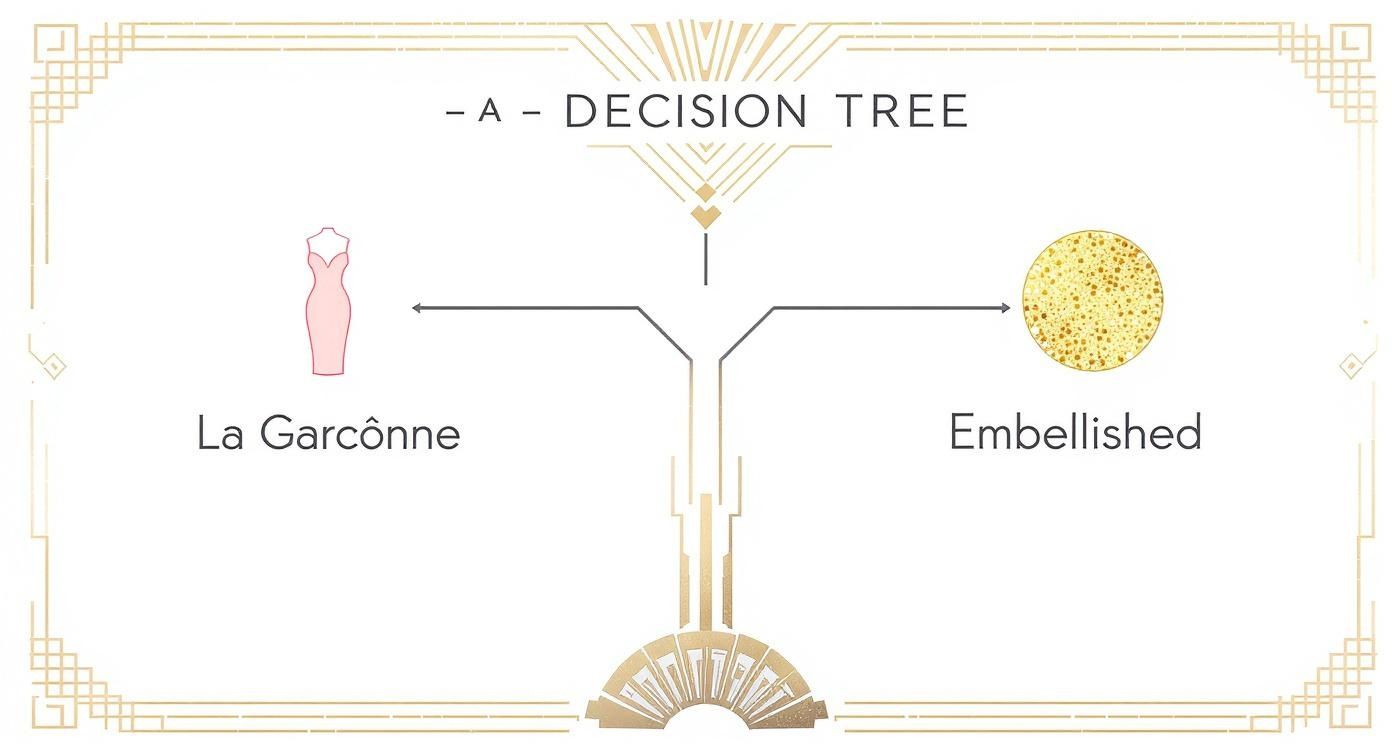
Whether your style leans more toward minimalist chic or dazzling glamour, figuring out these two main paths will really help narrow down your search for the perfect dress.
To help you spot the differences when you're out shopping, here's a quick side-by-side comparison:
Vintage vs. Reproduction Comparison
| Characteristic | Authentic Vintage (1920s) | Modern Reproduction |
|---|---|---|
| Fabric | Natural fibers like silk, chiffon, crepe de chine. Feels delicate, may show age. | Synthetic materials like polyester or nylon. Feels sturdy and durable. |
| Beading | Hand-sewn glass or metal beads. Slight irregularities, knots on the inside. | Machine-sewn plastic or acrylic beads. Perfectly uniform rows. |
| Closures | Snaps, hooks-and-eyes, or buttons along the side seam. No zippers. | Zippers (often plastic and centered on the back). |
| Weight | Surprisingly heavy, especially if beaded, due to glass beads and silk. | Lightweight, even with extensive beading, due to plastic components. |
| Construction | Fine details like French seams or pinked edges. Hand-finishing is common. | Simpler construction, often with overlocked (serged) seams. |
| Lining | Often has a separate silk slip or no lining at all. | Usually has a built-in polyester lining attached to the dress. |
This table is a great starting point, but always trust your hands and your eyes—the feel of the fabric and the look of the craftsmanship will tell you a lot.
Final Checks for Authenticity
Don't forget to peek at the internal construction! True vintage garments often have sophisticated sewing techniques that you just don't see in fast fashion today.
- French Seams: Look for enclosed seams where the raw edges are neatly tucked away. This was a common high-quality finish.
- Pinked Edges: Some seams might be finished with zig-zag cuts from pinking shears to prevent fraying.
- Weight: An authentic beaded dress will feel surprisingly heavy because they used real glass beads, not the lightweight plastic ones you find on many modern costumes.
Ultimately, choosing between vintage and a replica really just comes down to your purpose. For a collector, nothing beats the history and story of an authentic piece. But for a night of dancing, a durable and beautiful reproduction is often the more practical, worry-free choice.
How to Style a Flapper Dress Today
Bringing a 1920s flapper dress into today’s world is all about finding that perfect balance. You want to capture the free-spirited glamour of the Roaring Twenties without looking like you’re heading to a costume party. It's really about channeling the vibe, not just copying a historical look.
The trick is to let the dress do the talking. A heavily beaded or fringed dress is already a major statement piece. Instead of piling on every single period-correct accessory you can find, pick one or two key elements that give a nod to the era. This keeps the whole look feeling fresh and modern.
Mastering Modern Accessories
This is where you can really have fun and bridge the gap between vintage and modern. Think of your accessories as the secret sauce for personalizing the flapper aesthetic. Instead of going full head-to-toe historical, just sprinkle in a few pieces that whisper "1920s."
A few iconic accessories are all you need to get the point across:
- Jewelry: Is there anything more quintessentially flapper than a long strand of pearls? You can loop it or let it hang low to play up the drop-waist silhouette. For a more contemporary feel, try some art deco-inspired geometric earrings or a delicate beaded clutch.
- Headwear: A feathered headband is a classic for a reason, but it can feel a little costumey for most events. A sleek cloche hat is a much more chic and wearable choice. It frames the face so beautifully and adds a genuine touch of 1920s class.
- Footwear: Shoes are everything—they totally ground the look. You can lean into the era or just give it a subtle nod. Either way, finishing your outfit with some elegant vintage-inspired footwear is the way to go. T-strap heels or cute Mary Janes are perfect; they look the part and are sturdy enough for a night of dancing.
Learning https://www.lennylane.com/blogs/jenksbrands/how-to-accessorize-an-outfit is a skill that pays off, helping you mix and match vintage and modern pieces like a pro. This way, your outfit feels totally intentional and stylish, not theatrical.
Hair and Makeup with a Modern Twist
That classic 1920s beauty look—the sharp bob, dark smoky eyes, and a cupid's bow lip—is undeniably gorgeous. But let's be real, a direct copy can look a little harsh today. The key is to soften these elements for a more modern vibe.
The modern way to rock a flapper look is to treat the dress as the main event. Your accessories, hair, and makeup should be the supporting cast. This keeps you from looking dated and really lets your own style shine.
If you don't have a bob, no worries! You can create a convincing faux bob just by pinning longer hair under. Soft finger waves that frame your face are another beautiful tribute to the era that works on almost any hair length.
For makeup, think "inspired by," not "identical to." Try a smudgy, blended smoky eye instead of that severe, kohl-rimmed look they wore back then. Pair it with a bold berry or deep red lipstick, but apply it to your natural lip shape. It's a much softer, more modern finish that still has all the drama.
A Practical Guide to Buying Your Flapper Dress
Finding the perfect 1920s flapper dress is such a thrill, whether you’re digging through a tiny vintage boutique or scrolling through online shops for hours. Knowing what you're looking for is everything—it turns what could be an overwhelming search into a fun, successful hunt. It really all comes down to understanding the fit, the fabric, and the little details that make or break a dress.
First up: the silhouette. A real flapper dress isn't meant to be tight or clingy at all. These dresses were designed to hang loose and straight from the shoulders, with a drop waist that hits down around the hips. This cut was all about freedom of movement—you had to be able to do the Charleston, after all! So when you try one on, fight the urge to find a size that hugs your curves. You're looking for a fit that lets you shimmy and sway with total ease.
Shopping In-Store Versus Online
Walking into a real vintage store is amazing because you can get your hands on everything. You can feel the fabric, get a good look at the beadwork, and check out the seams up close. When you think you've found the one, give it a serious once-over.
- Fabric Integrity: Hold that fabric up to a light. You're looking for any spots where the silk or chiffon is getting thin, yellowing, or showing signs of stress.
- Bead and Sequin Loss: Check for loose threads or obvious gaps in the beading, especially under the arms and along the hem—those spots get a lot of wear and tear.
- Seam Strength: Gently check the side seams and shoulder seams. On a true vintage piece from a century ago, these can be incredibly fragile.
Shopping online is more like being a detective. You can't touch the dress, so detailed photos and a seller you can trust are your best friends. Don't be shy about asking for more pictures! Get close-ups of the beading, the lining, and any buttons or snaps.
Heads up: vintage sizing is a whole different world from what we use today. A size 16 from the 1920s is actually closer to a modern US size 6 or 8. Always, always go by the measurements the seller provides for the bust, waist, and hips, and measure yourself to compare.
Making a Confident Purchase
When you're buying online, you have to know the seller's policies. Check out their return policy before you even think about buying, just in case the fit or condition isn't what you were hoping for. Good sellers will give you super-specific measurements and be upfront about any little flaws, so read the description like it’s your job.
Focusing on shops that are known for their quality can save you a lot of headaches. If you're new to this, it helps to learn a bit about what makes a garment well-made. You can check out a helpful guide to quality womens clothing brands to get a better feel for spotting good craftsmanship.
Whether you're holding a dress in your hands or falling in love with it on a screen, this approach will help you shop like a pro. By keeping an eye out for the right silhouette, carefully checking the condition, and triple-checking those measurements, you'll be ready to find a fantastic flapper dress that you'll absolutely adore.
How to Preserve and Care for Your Flapper Dress
Okay, so you’ve found the one. Whether it's a true vintage 1920s flapper dress or a stunning modern piece, you need to treat it with a special kind of love. These dresses are seriously delicate, and the combination of fragile fabrics and all that heavy beading means one thing: the washing machine is its absolute worst enemy. Seriously, don't even think about it.
For little spills and smudges, spot cleaning is your best friend. A tiny bit of mild, diluted detergent and a gentle touch will usually do the trick. If you absolutely have to give it a full clean, it has to be done by hand. I’m talking lukewarm water, a whisper of silk-safe soap, and just a few minutes of submersion. No scrubbing, no wringing. Just a gentle dip.
Smart Storage Is Everything
Honestly, how you store your dress is probably even more important than how you clean it. Gravity is not your friend here, and neither are light or pests. But the good news is, they're all pretty easy to outsmart.
The golden rule for any beaded flapper dress is to never, ever store it on a hanger. I can't stress this enough! The weight of all those gorgeous beads will slowly but surely stretch the fabric out of shape, and once that happens, there's no going back.
Instead, just follow these simple steps to keep your dress looking perfect for decades to come:
- Prep It First: Make sure the dress is completely clean and dry before you even think about putting it away. Any leftover moisture or tiny stains can attract bugs and cause the fabric to weaken over time.
- Get Some Acid-Free Tissue: Gently fold the dress, tucking layers of acid-free tissue paper in between the folds. This little trick prevents harsh creases and stops any beads or sequins from snagging on each other.
- Lay It Flat: Place your tissue-wrapped beauty inside an archival box or a clean, dry drawer. Storing it flat takes all the pressure off the seams and delicate fabric, keeping it in its original, fabulous shape.
Still Have Questions About Flapper Dresses?
It's totally normal to have a few questions when you start diving into the world of 1920s flapper dresses. I get asked about these all the time! Let's clear up some of the most common ones.
First up: the hemline. Everyone wants to know just how short they really were. For their time, they were scandalous! Most flapper dresses hit right below the knee, which was a huge deal back then. It was a bold statement of freedom, letting women move, dance the Charleston, and even drive without being tripped up by those old floor-length styles. It was as much about practicality as it was about rebellion.
And what about the shoes? This is another big one. Flappers lived in T-strap heels and Mary Janes. The secret was the strap across the top of the foot—it locked their shoes in place so they could dance all night without a wardrobe malfunction.
So, Can I Actually Wear a Real 1920s Dress?
This is the million-dollar question. While you technically could wear an authentic vintage dress, I almost never recommend it for a party or event. After 100 years, fabrics like silk and crepe become incredibly delicate. Add the sheer weight of all those glass beads, and you've got a recipe for disaster. One wrong move and you could cause a tear.
For hitting the dance floor, a high-quality modern reproduction is a much safer—and smarter—bet. You get all the style without the stress, and you help preserve these beautiful historical pieces for future generations to enjoy.
Think of a real flapper dress like a first-edition book. It’s a precious piece of history you want to protect and admire. For actually reading, you'd grab a modern paperback, right? It's the same idea when you learn how to build a capsule wardrobe; you mix those timeless, durable essentials with a few special statement pieces.